
Controls
About this game
Building the Royal Barrier
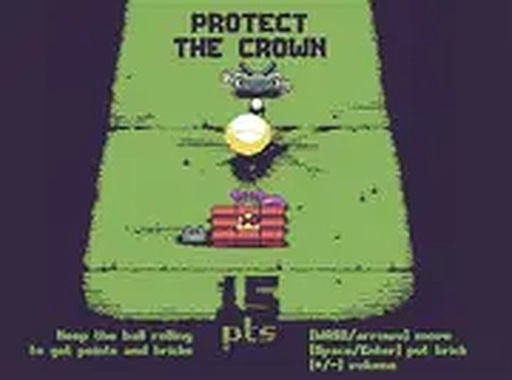
Each round in Crown Defense Block Builder starts with a crown at one end of the play area and a ball that will soon begin bouncing. You arrange blocks into a protective wall in front of the crown before the ball is released. The game gives you full control over block placement, so you can build solid lines, angled surfaces, or layered barriers. Since the ball bounces unpredictably, you must anticipate possible paths and balance coverage against the number of blocks available.
You Are the Last Block
After placing your wall, you position your character as the final barrier. This is the game's defining twist: your character is directly vulnerable. If the ball touches you, points are deducted. That creates a genuine tension between protecting the crown and avoiding personal loss. You might stand in a safe spot behind your wall, or take a risk to plug a gap. Each round forces a decision about how much personal risk to accept.
How Rounds Unfold
The cycle is consistent: plan your wall, place your blocks, position yourself, then react as the ball moves. The design phase carries most of the strategic weight because the ball's unpredictable bounces punish weak layouts. [IMG_1] The visual style is clean and focused, with the crown and blocks easily distinguishable, so you can track the ball without distraction. The game runs in a browser using WebGL and supports full-screen mode for a clearer view of the play area.
Progression and Session Length
Crown Defense Block Builder may include multiple levels or challenges that gradually increase in difficulty. As you advance, the ball might move faster or available blocks could become more limited, encouraging you to refine your strategies. The game is free to play with no download required, making it easy to return for quick sessions. Each attempt offers a chance to improve your score and discover more effective defenses.
Compatibility
Screenshots
How To Play
Player Reviews
Crown Defense Block Builder combines block placement with a personal risk mechanic: your character serves as the final barrier, and any contact with the ball costs points. The design phase rewards forward thinking about bounce paths, while the reactive phase tests positioning under pressure. The clean visuals and WebGL browser support make it easy to pick up for short sessions. Players who enjoy physics-based defense puzzles and incremental difficulty will find the most value here, though the experience is intentionally simple rather than feature-rich.
Comments
Sign in to leave a review
Share your rating and tip other players.
No comments yet.






Editorial Notes