
Controls
About this game
Matching Cars to Passengers
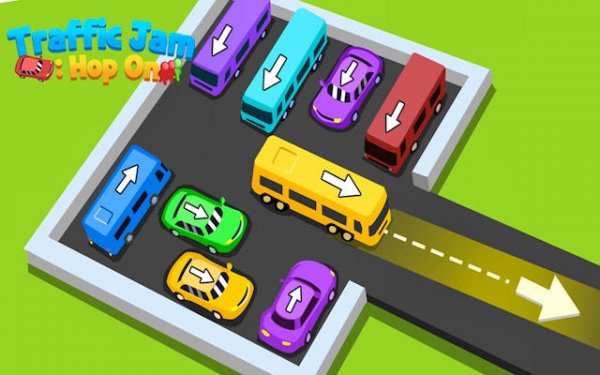
Every car in Traffic Jam Hop On carries a directional arrow and a specific color. Passengers wait at the edges of the lot, and each one needs a car that matches both color and size. A small red car cannot carry a group that requires a larger vehicle, so you must check the number of people before choosing. This matching layer turns simple movement into a logic problem: the right car might be blocked by three others that need to move first. [IMG_1]
Reading the Lot Before You Move
Each level presents a unique arrangement of vehicles. Before touching anything, scan the whole board. Note which cars are free to move and which are boxed in. Because cars only travel along their arrows, a single wrong move can create a deadlock where no car can reach its passenger. The game rewards patience over speed. Move one car at a time, watch how the empty space shifts, and adjust your plan when a path closes unexpectedly. [IMG_2]
Tools for Stuck Moments
When the lot becomes too tangled, hints and shuffles are available. A hint suggests a productive next move, while a shuffle rearranges the board to break a deadlock. These tools are not a substitute for planning, but they prevent frustration when a puzzle seems unsolvable. Using them wisely keeps the session moving without removing the satisfaction of solving the layout yourself.
Difficulty That Grows Gently
Early levels use few cars and wide-open paths, making the color-and-size rule easy to learn. Later arrangements pack more vehicles into tighter spaces, so you must plan several moves ahead. The absence of a timer means you can study each board as long as you like. That design suits casual players who want a calm mental workout, while the rising complexity gives puzzle fans a reason to keep clearing lots.
Compatibility
Screenshots
How To Play
Player Reviews
Traffic Jam Hop On: Parking Puzzle delivers a straightforward logic challenge: move the right car to the right passenger without creating a deadlock. The color-and-size matching rule adds a layer beyond simple sliding puzzles, and the lack of a timer makes it welcoming for casual players. Progressive difficulty keeps puzzle fans engaged. Its main limitation is that the core loop stays consistent throughout, so players seeking varied mechanics may find it repetitive over long sessions.
Comments
Sign in to leave a review
Share your rating and tip other players.
No comments yet.





Editorial Notes